Hire a RAG Development Company to Build Reliable, Data-Backed AI
Large language models are powerful, but they’re limited to what they’ve been trained on. When your business needs AI that can accurately answer questions based on internal policies, product documentation, client data, or proprietary knowledge, relying on generic model training simply isn’t enough. That’s where our RAG Development Services come in. At NextGenSoft, we connect advanced AI models with your real-time business data using Retrieval Augmented Generation, ensuring every response is context-aware, accurate, and relevant.
As a trusted RAG Development Company, we build end-to-end, production-ready RAG pipelines tailored to your business goals. From document ingestion and data preprocessing to embedding generation, vector database design, intelligent retrieval strategies, and LLM response optimization, we handle the complete architecture.
Our RAG Development Services Benefits
Factually Accurate AI Responses
RAG grounds every AI response in retrieved documents from your verified knowledge base, dramatically reducing hallucinations and ensuring your AI only says what your data actually supports.
No Model Retraining Required
Instead of expensive fine-tuning or retraining cycles, RAG lets you update your knowledge base in real time. Add new documents and your AI immediately has access to the latest information.
Domain-Specific Intelligence
Your AI understands your industry terminology, internal processes, and proprietary data, because it is retrieving from your documents, not generating from general training data.
Faster Enterprise Adoption
RAG application development systems integrate with your existing document storage, wikis, & databases without requiring a full data migration. Your team’s existing knowledge becomes the AI’s knowledge source.
Auditable and Explainable Outputs
Every RAG application response can cite the exact source documents it retrieved. This makes AI outputs auditable, trustworthy, and compliant, critical in regulated industries and enterprise environments.
Challenges of Implementing RAG Without Domain Expertise
RAG may look simple in demos, but building a reliable, production-ready system takes expertise, partner with a trusted RAG development company to get it right.
Poor Retrieval Quality Accuracy
If your retrieval step returns the wrong chunks, the LLM generates a confidently wrong answer. Chunking strategy, embedding model selection, and retrieval configuration are not defaults you can skip; they determine whether your RAG system is useful or dangerous.
Unstructured Data is Complex
PDFs, scanned documents, tables, slides, and mixed-format files require specialised preprocessing before they can be embedded and retrieved effectively. Teams that skip proper ingestion pipelines end up with a vector store full of noise.
Latency & Costs Escalate Fast
Naive RAG implementations retrieve too many chunks, make too many LLM calls, and return responses too slowly for real-world use. Production RAG requires careful reranking, caching, and retrieval budget management to stay fast and cost-efficient.
No Evaluation, No Trust
Most teams build a RAG system and test it manually. Without a structured evaluation pipeline measuring retrieval recall, answer faithfulness, and answer relevance, you cannot know if your RAG system is actually working or when it degrades.
Our Standards for Building Production-Grade RAG Systems
Document Ingestion and Preprocessing
We start with your raw data sources, PDFs, Word docs, HTML, databases, APIs, and build a robust ingestion pipeline that cleans, structures, and normalises content before it ever reaches the vector store. Garbage in, garbage out applies directly to RAG.
Embedding Model Selection for Your Domain
We evaluate and select the embedding model best suited to your content type and retrieval use case, whether that is OpenAI’s text-embedding-3, a domain-specific open-source model, or a fine-tuned embedding for highly specialised terminology.
Chunking Strategy Designed Around Retrieval
Chunk size and overlap are not arbitrary numbers. We design chunking strategies that preserve semantic coherence, respect document structure, and align with your LLM’s context window, because how you split documents directly determines what the model can reason over.
Hybrid Search for Maximum Recall
We combine dense vector search with sparse keyword search (BM25) to maximise retrieval recall across both semantic similarity and exact term matching, ensuring your system finds relevant content even when users phrase queries unexpectedly.
Reranking to Maximise Precision
Retrieved chunks are reranked using a cross-encoder model before being passed to the LLM, filtering out marginally relevant results and ensuring the model reasons over the highest-quality context available.
RAG Evaluation Pipeline Built In
Every RAG system we build includes a structured evaluation framework measuring retrieval recall, answer faithfulness, and answer relevance, so you have quantitative confidence in your system’s performance, not just a gut feel.
RAG Trends Defining Enterprise AI Deployments in 2026
The Evolution of RAG in Enterprise AI
General-purpose LLMs without grounding are being phased out of serious enterprise AI programs. RAG-first architecture is now the baseline expectation for any AI system that needs to be accurate, auditable, and domain-specific.
Next-Gen RAG: Smarter, Broader, Autonomous
Microsoft's Graph RAG approach, which builds a knowledge graph over your documents before retrieval, is showing significant accuracy improvements for queries that require reasoning across multiple interconnected concepts, not just similarity search.
RAG Transformation in Modern AI Systems
RAG systems are expanding to handle images, diagrams, charts, and audio alongside text, enabling AI systems to reason over technical documentation, product catalogues, and multimedia knowledge bases that plain text retrieval cannot handle.
Advanced RAG Architectures Shaping AI
Instead of a fixed retrieve-then-generate pipeline, agentic RAG systems dynamically decide when to retrieve, what to query, and whether to retrieve again if the first attempt is insufficient, producing significantly better results on complex, multi-part questions.
The New Era of RAG-Driven Intelligence
Tools like RAGAS and DeepEval are standardising how teams measure RAG system quality. Enterprises are now requiring structured evaluation scores, not just human spot-checks, before RAG systems go to production.
RAG Innovations Powering Enterprise AI
Financial services, healthcare, and legal sectors are deploying fully on-premise RAG stacks, open-source embedding models, self-hosted vector databases, and locally deployed LLMs to meet data residency and regulatory requirements without sacrificing capability.
Why Choose NextGenSoft for RAG Development?
Beyond Basic RAG Implementation
Chunking strategy, hybrid search, reranking, evaluation pipelines, and ingestion preprocessing are where most RAG projects quietly fail. These are exactly where we invest the most engineering effort, because a RAG system that retrieves the wrong content will always generate the wrong answer, no matter how good the LLM is.
Flexible Vector Store Integration
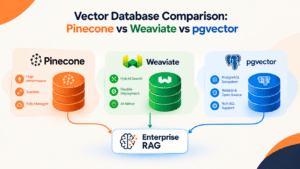
We work with Pinecone, Weaviate, ChromaDB, pgvector, and Qdrant. We recommend the vector store that fits your existing infrastructure, scale requirements, and budget, not the one that generates the highest partner margin. If you already have PostgreSQL, pgvector may be the right answer. We will tell you honestly.
Enterprise-Grade Data Security
Your internal documents, knowledge bases, and proprietary data are the foundation of your RAG system. Our ISO/IEC 27001:2022 certified processes ensure that your data is ingested, stored, and used under enterprise-grade security controls, with full documentation of data flows for your compliance teams.
Data-Driven Performance Validation
We do not hand over a RAG system and tell you it “feels accurate.” We build an evaluation pipeline into every delivery, measuring retrieval recall, answer faithfulness, and answer relevance with quantitative scores you can track over time and present to stakeholders.
RAG Development Tools and Frameworks We Work With
- RAG & Orchestration Frameworks
- Vector Stores & Search Infrastructure
- Embedding Models
- Ingestion and Processing Tools

Pranav Lakhani 

Niraj Salot